
Ensuring successful project delivery to maximise results.
From the initial business case through project completion and operational transition, we assume full responsibility for ensuring the achievement of your planned objectives.
Our methodology is tailored to the specific complexity of each project. We apply an agile approach, leveraging our expertise in construction management, logistics, risk management, stakeholder engagement, and scheduling to consistently deliver exceptional performance in partnership with our clients.
Project management follows five fundamental phases present in all project plans:
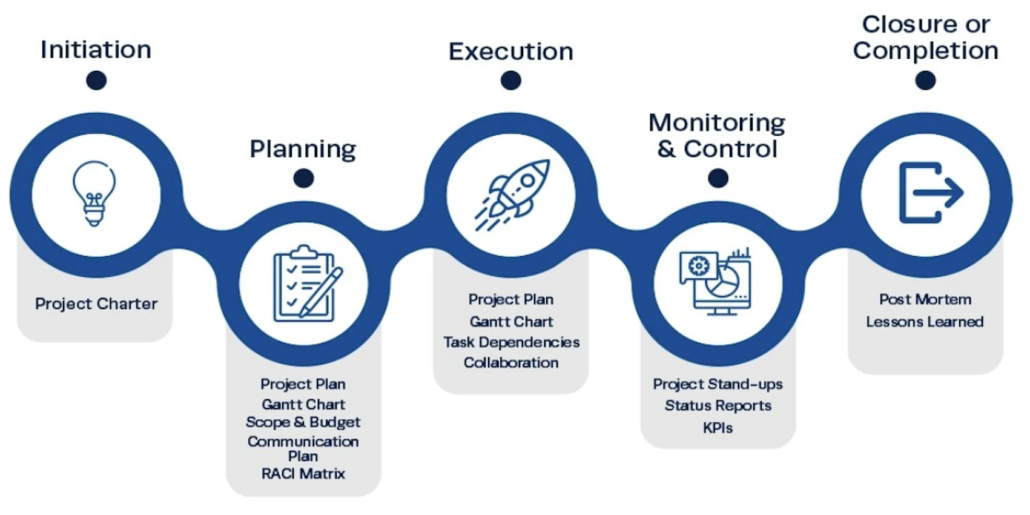
Initiation
In this opening phase, the project’s scope is checked for alignment with business goals and value. Considerations extend to both internal and external stakeholders. Discussions take place between managers and stakeholders, while success criteria are established relative to the project’s timeline. Key documents such as a stakeholder register, and scope statement are prepared.
Planning
The second stage encompasses drafting a comprehensive project plan, including procedures, processes, resource allocation, and deadlines. Project experts communicate requirements to teams, ensuring everyone understands objectives and targets. Essential frameworks like Work Breakdown Structure, communication channels, scheduling, and budgeting are devised here.
Execution
During execution, teams follow the established plans and processes to complete assigned tasks. The project manager maintains strict adherence to these plans, focusing on quality assurance so that work meets predefined standards.
Monitoring & Control
This fourth phase is about supervising the project’s progress. The project manager tracks performance indicators, team productivity, schedules, and task fulfilment, aiming for consistent achievement of objectives. Should delays occur, monitored data helps justify requests for extensions, and accurate metrics enhance communication with external stakeholders.
Completion or Closure
The final phase marks the successful accomplishment of all tasks and adherence to necessary processes. Documentation is delivered to relevant stakeholder boards, and formal closure of the project takes place.
Benefits of Project Management to Organizations:
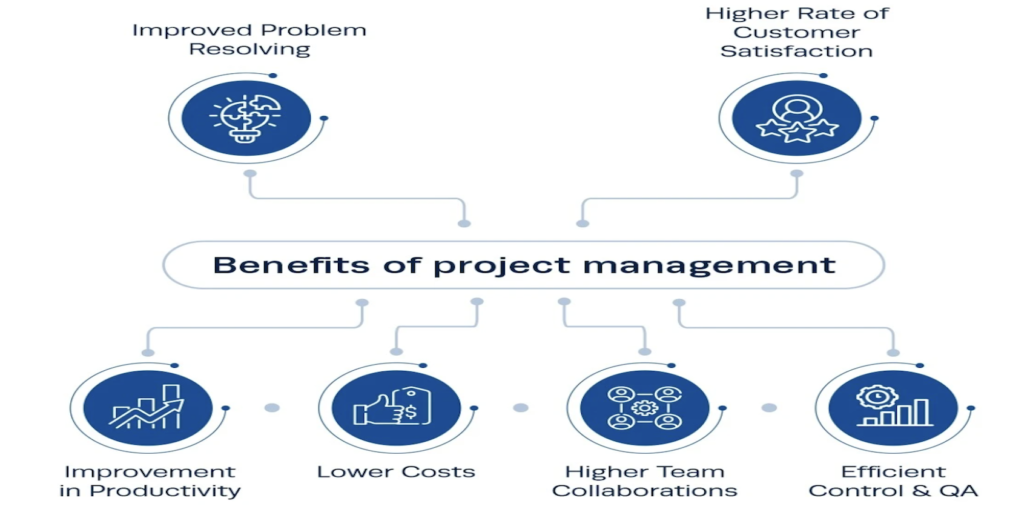
Project management offer numerous advantages to organizations. It can be demonstrated as below:
Increased Productivity
Project management processes help optimize resource productivity. Resource managers, project managers, and team members collectively boost an organization’s output.
Reduced Costs
Efficient scheduling and strategic use of resources, guided by expert project management skills, significantly lower project expenses. Project managers ensure that projects are completed within budget constraints, further reducing costs.
Enhanced Team Collaboration
Project management fosters high levels of teamwork and integration. Given complex projects, appointing a team leader is essential. Regular communication, thorough workflow checks, quality assurance, skill sharing, and coordinated expertise drive teams toward successful project completion.
Effective Control & Quality Assurance
Project management includes rigorous phases for testing and ensuring deliverable quality. This guarantees that customers receive products meeting high standards within established budget and timeframes. Organizations trust project managers because they consistently deliver assured quality.
Greater Customer Satisfaction
Delivering projects at high-quality standards increases customer value compared to unoptimized production methods. As a result, project management leads to higher customer satisfaction, improved waste management, fewer errors, and better resource utilization.
Improved Problem Solving
Projects inevitably encounter challenges. Early identification and prompt resolution are crucial. Project managers focus on mitigating risks and addressing issues quickly, encouraging a proactive approach to problem solving in the organization.